Quick Answer: Which Annotation Type Should You Use?
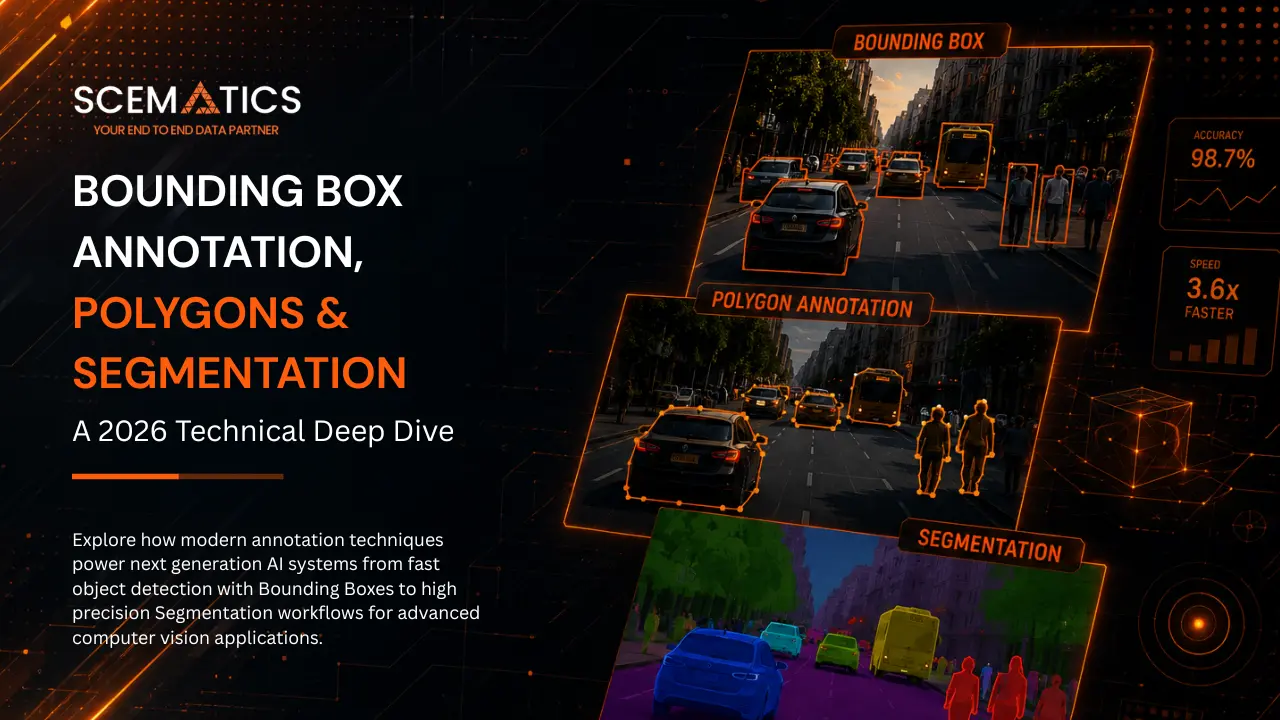
Choose bounding box annotation for object detection tasks where location and class label are sufficient. Choose polygon annotation when object shape affects model decisions and background noise from rectangles would degrade training signal. Choose segmentation annotation for pixel-level scene understanding or per-object instance tracking. The cost difference between these choices ranges from $350 to $5,000 or more for the same 5,000-image dataset.
Why Annotation Type Is an Engineering Decision With Downstream Consequences
The choice of annotation type is upstream of every subsequent decision in a computer vision pipeline. It determines which model architectures the training data can support, how precisely the model learns object boundaries, and what the practical cost of building the dataset is.A team that annotates a dataset with bounding boxes and then decides mid-project that their model needs pixel-level boundary information must re-annotate from the beginning. There is no conversion path from bounding box labels to segmentation masks without generating entirely new annotations. This makes the annotation type decision a commitment that is expensive to reverse.
Three Annotation Types, Three Positions on the Precision-Cost Spectrum
Bounding box annotation is fast, inexpensive, and sufficient for the majority of object detection tasks. Polygon annotation is slower and more expensive but captures object shape accurately, which matters when boundary precision affects model performance. Segmentation annotation is the most precise and the most resource-intensive option, and is necessary for tasks where every pixel in the image carries training signal.The three types occupy distinct positions on the precision-cost spectrum, and the right choice is determined by the task the model must perform, not by a preference for higher annotation quality in general. Over-annotating wastes budget without proportional gain. Under-annotating produces models that fail on boundary-sensitive tasks where the training data did not provide sufficient spatial information.
The Cost of Getting It Wrong
A team that defaults to segmentation annotation on a dataset where bounding boxes would suffice multiplies annotation cost by an order of magnitude without proportional benefit on the target task. A team that uses bounding boxes for a medical imaging model that requires precise lesion boundary localization produces a model that fails at the task it was built for, requiring the dataset to be rebuilt. Getting the annotation type right the first time is the highest-leverage decision in dataset construction.
Bounding Box Annotation: Where It Stands in 2026
Bounding box annotation draws a rectangle around each object of interest, defined by the coordinates of the top-left corner plus the width and height of the box. It is the most widely used annotation type in production computer vision, and the benchmark datasets that drive model development are built primarily on bounding box labels.The COCO dataset, with its 80 object categories and 330,000 images, is the primary benchmark for object detection model evaluation. Every major YOLO variant is trained on and evaluated against bounding box labels on COCO.
2026 COCO Benchmark Results
YOLO11, released in late 2024, achieves a COCO mAP (averaged across IoU thresholds from 0.50 to 0.95) of 39.5 for the nano variant and 54.7 for the extra-large variant. YOLO12, released February 2025, improved on YOLO11n by 1.2 percentage points on the COCO val2017 dataset.YOLO26, released September 2025 as the current recommended Ultralytics production model, achieves 53.0 to 53.4 mAP for the large variant, with the nano variant at approximately 39.8 mAP. These figures confirm that top-performing production models trained on bounding-box-annotated datasets reach strong accuracy on the COCO benchmark.
Cost and Speed: 2026 Market Pricing
Bounding box annotation pricing in 2026 ranges from $0.03 to $0.20 per image for standard object detection tasks, according to GigaBPO pricing benchmarks. LTS GDS published per-object pricing of $0.02 to $0.04 per annotated object. For a 5,000-image dataset, bounding box annotation costs approximately $350 to $900 depending on object complexity and objects per image.Annotation speed is the principal advantage of bounding boxes. Drawing a rectangle around an object takes seconds. The same object labeled as a polygon or segmentation mask takes minutes. At dataset scale, this time difference translates directly into the cost difference between annotation types.
The Background Noise Limitation
Bounding box annotation's fundamental limitation is that rectangles are a poor fit for irregular objects. When a bounding box is drawn around an object with complex boundaries, a portion of the box area captures background rather than object. That background enters the training data as foreground signal.A 2025 comparative study using YOLOv8 found that polygon annotations deliver 15 to 30 percent higher mask IoU than bounding boxes on objects with complex or irregular shapes. This gap compounds in scenes where objects overlap or are densely packed, because background noise from overlapping bounding boxes creates ambiguous training signals that degrade both precision and recall.
Polygon Annotation: Accuracy and Cost Data for 2026
Polygon annotation traces the actual contour of an object using a series of connected vertices. The resulting annotation closely follows the object boundary, capturing object shape rather than merely object location. This precision advantage is the reason polygon annotation is preferred for tasks where model decisions depend on knowing exactly where an object ends.
The IoU Advantage: Quantified
Polygon annotations deliver 15 to 30 percent higher mask IoU than bounding boxes for objects with complex shapes, according to Label Your Data's 2026 polygon annotation guide. A polygon label that accurately traces an object boundary excludes background pixels from the training mask. A bounding box label for the same object includes whatever background falls within the rectangle, which can represent a significant proportion of the label area for irregularly shaped objects.The IoU advantage of polygon annotation is most pronounced in domains where objects have highly irregular outlines. Agricultural annotation of individual crop plants or disease zones, manufacturing defect marking, medical lesion outlining, and dense urban scenes in autonomous driving all show consistent polygon outperformance on boundary-sensitive metrics.
Time Cost: What Production Data Shows
The time required for polygon annotation scales with the complexity of the object outline. Label Your Data's 2026 benchmark documented the Cityscapes dataset as a reference case: fine-grained polygon annotations of dense street scenes required 90 minutes per image, compared to 7 minutes per image for coarse annotations. That 13x multiplier represents an extreme case involving highly complex urban scenes.For objects of moderate complexity, polygon annotation takes 3 to 10 times longer than bounding box annotation. AI-assisted polygon annotation tools using SAM 3 edge-snapping and auto-contour generation reduce annotation time by 40 to 60 percent compared to manual tracing. Human review and correction of the AI-generated contours remains necessary for production-quality output.
Cost Benchmarks: Polygon vs Bounding Box
Polygon annotation pricing in 2026 starts at $0.06 or higher per label compared to $0.02 to $0.04 per object for bounding boxes. For a comparable 5,000-image dataset with moderately complex objects, polygon annotation costs are typically 3 to 5 times higher than equivalent bounding box annotation.Specialist domains such as medical imaging or satellite analysis push this multiplier higher, as annotation requires subject matter expertise in addition to technical precision. AI-assisted polygon tooling is closing this gap on platforms that support SAM 3 integration, but the human review step remains the primary cost driver.
Segmentation Annotation: Semantic vs Instance, With 2026 Benchmarks
Segmentation annotation assigns a class label to every pixel in the image. This is the highest-precision annotation type and the most resource-intensive to produce. Two distinct variants serve different tasks, and the choice between them has meaningful consequences for model architecture and training data requirements.
Semantic Segmentation
Semantic segmentation labels every pixel with a class, treating all instances of the same class as a single entity. Two adjacent cars in a scene are both labeled as vehicle at the pixel level, but the annotation does not distinguish where one car ends and the other begins. This makes semantic segmentation appropriate for tasks where the model needs to understand scene composition and classify every region, without needing to count or individually identify objects.Autonomous vehicle scene parsing, land use classification from satellite imagery, and medical imaging analysis where tissue type across the full image carries diagnostic value are the primary applications of semantic segmentation annotation.
Instance Segmentation and 2026 Benchmark Performance
Instance segmentation assigns a separate pixel mask to each individual object, regardless of class. Two cars in the same scene receive distinct masks, enabling counting, tracking, and precise per-object boundary detection. Instance segmentation is the most information-dense annotation type and produces training data for models that need to operate at the level of individual object instances.In 2026, SAM 3 (Meta Segment Anything Model 3, released November 2025) set a new benchmark for zero-shot instance segmentation on the LVIS dataset, achieving a mask Average Precision of 48.8 compared to the previous state-of-the-art of 38.5. YOLO11, which supports both bounding box detection and instance segmentation, demonstrates that segmentation-trained models achieve significantly higher boundary accuracy on complex objects than their bounding-box-only equivalents.
Segmentation Cost: The 2026 Premium
Segmentation annotation carries a substantial cost premium. According to GigaBPO's 2026 pricing benchmark, semantic segmentation of the same 5,000-image dataset that costs $350 to $900 with bounding boxes costs $3,000 to $5,000 or more.BasicAI's 2025 pricing guide puts high-precision medical or scientific image segmentation at $2.00 to $8.00 per image. Lightly.ai's 2026 annotation company comparison confirms that semantic segmentation and polygon annotation of medical imaging or 3D point cloud data can cost 10 to 50 times more than basic bounding boxes, driven by the expertise and time required.
2026 Benchmark Comparison: Annotation Types at a Glance
The table below summarizes the key metrics for bounding box, polygon, and segmentation annotation as of 2026, using published benchmark data from COCO detection leaderboards, YOLO model evaluations, and vendor pricing surveys.
| Metric | Bounding Box | Polygon | Segmentation |
|---|---|---|---|
| Boundary precision | Low (rectangle approximation) | High (contour-accurate) | Highest (pixel-level) |
| Mask IoU vs bounding box | Baseline | +15 to 30% IoU gain | Highest (all pixels labeled) |
| Annotation time multiplier | 1x baseline | 3 to 10x longer | 10x+ longer (complex scenes) |
| Cost: 5,000-image dataset (2026) | $350 to $900 | 3 to 5x bounding box cost | $3,000 to $5,000+ |
| COCO/LVIS performance (2026) | YOLO26: 53.0+ mAP; YOLO11: 39.5 to 54.7 mAP | Task-dependent (not directly comparable to detection mAP) | SAM 3: 48.8 mask AP on LVIS zero-shot |
| Distinguishes object instances | No | Partial | Yes (instance segmentation) |
| AI-assist benefit (2026 tools) | Moderate (auto-box generation) | High (SAM 3 edge-snapping, 40 to 60% time reduction) | Highest (SAM 3 single-click mask generation) |
| Primary use cases | Object detection, counting, classification | Shape-sensitive detection, agricultural AI, medical imaging | Pixel-level scene parsing, autonomous driving, satellite analysis |
Annotation Type Selection: A 2026 Decision Framework
The annotation type decision is a function of four variables: the task the model must perform, the shape complexity of the objects being annotated, the budget available for annotation, and the quality threshold required. Applying these variables in order produces a defensible annotation strategy.
Object Detection Where Location and Class Are Sufficient
Bounding box annotation is the correct choice. Current production models (YOLO26, YOLO12, YOLO11) achieve strong COCO mAP on bounding-box-annotated datasets. The annotation cost is the lowest of the three options, and the format is natively supported by every major detection architecture. For datasets where objects are roughly rectangular, bounding boxes introduce minimal background noise and provide sufficient training signal for high-performing models.
Tasks Where Object Shape Affects Model Decisions
Polygon annotation provides the boundary precision that bounding boxes cannot, at a cost that is manageable with AI-assisted tooling. The 15 to 30 percent IoU improvement over bounding boxes is a meaningful gain for applications in agricultural AI, manufacturing defect detection, and medical imaging where boundary accuracy drives downstream decisions. SAM 3-assisted polygon annotation reduces the effective cost premium by 40 to 60 percent on platforms that support it.
Pixel-Level Scene Understanding or Per-Object Instance Tracking
Segmentation annotation is the appropriate choice. The 2026 cost premium is substantial (10 to 50x for specialist domains) but reflects the genuine informational advantage of pixel-level labels for tasks that require it. For teams where cost is a binding constraint, AI-assisted segmentation with human review significantly reduces the effective per-label cost compared to fully manual segmentation. SAM 3 single-click mask generation makes segmentation annotation economically viable for datasets that previously required prohibitive manual effort.
Mixed Annotation Type Projects
Many production datasets use more than one annotation type across different object classes. Road markings in an autonomous vehicle dataset may use polylines; vehicles may use polygon annotation; traffic signs may use bounding boxes. The annotation platform needs to support mixed-type export formats that preserve per-class annotation type information consistently.
A mixed annotation strategy allows teams to apply the minimum annotation precision required for each object class, optimizing both cost and training data quality simultaneously. It requires more upfront schema planning but produces datasets that are more cost-effective than applying a single annotation type uniformly.
AI-Assisted Annotation in 2026: How SAM 3 Changes the Cost Equation
The cost premiums associated with polygon and segmentation annotation are substantially reduced on platforms that integrate SAM 3. Understanding what SAM 3 actually provides in an annotation workflow clarifies where the time savings come from and where human review remains essential.
What SAM 3 Provides for Polygon Annotation
SAM 3 edge-snapping allows an annotator to click near an object boundary and have the model snap the polygon vertex to the precise edge automatically. Auto-contour generation allows the annotator to provide a rough bounding indication and receive a polygon approximation of the object boundary that can be corrected as needed.These tools reduce annotation time by 40 to 60 percent compared to fully manual polygon tracing. The reduction is largest for objects with smooth, well-defined edges (where SAM 3 edge detection is most accurate) and smallest for objects with ambiguous or low-contrast boundaries (where correction rates are higher).
What SAM 3 Provides for Segmentation Annotation
SAM 3 achieves a mask AP of 48.8 on the LVIS dataset in zero-shot evaluation, a 10.3 percentage point improvement over the previous state-of-the-art. In annotation workflows, this translates to single-click mask generation for well-defined objects, reducing the manual work for segmentation annotation to a review and correction task rather than a creation task.The practical implication for annotation budgets is that segmentation annotation with SAM 3 AI assist can approach the effective cost of manual polygon annotation in many domains. The review step still requires human time, but the creation step is automated for the majority of objects in typical datasets.
Where AI Assistance Does Not Eliminate Human Review
AI-assisted annotation tools reduce creation time, not verification time. For any production dataset, human review of AI-generated annotations remains necessary. SAM 3 edge-snapping and mask generation produce high-quality outputs for objects with clear boundaries, but fail at predictable failure points: low-contrast edges, heavy occlusion, unusual object orientations, and domain-specific objects underrepresented in SAM 3 training data.Production annotation workflows should structure AI assistance as a pre-annotation step followed by mandatory human review, with correction rates tracked per object class. Object classes with consistently high correction rates may require annotator training or a switch to a domain-specific pre-annotation model via BYOM integration.
How Scematics Supports All Three Annotation Types
For teams evaluating annotation type alongside platform or service options, Scematics supports bounding box, polygon, and segmentation annotation with SAM 3-assisted tooling and BYOM (bring-your-own-model) integration for teams with domain-specific pre-annotation models.
Annotation Service for Specialist Domains
For annotation projects requiring domain specialist annotators, the Scematics labeling service pairs annotation expertise with the appropriate technique for each project requirement. The annotation team has 15+ years of CGI experience, providing domain expertise for complex annotation tasks that require specialized visual judgment.Quality verification is built into the delivery pipeline: an independent verification pass runs on every completed project before dataset export. For more on image annotation techniques including keypoints and polylines, see the image annotation guide.
Scematics Copyrights Reserved
Post comments
Comments