Quick Answer: Which Annotation Type Should You Use?
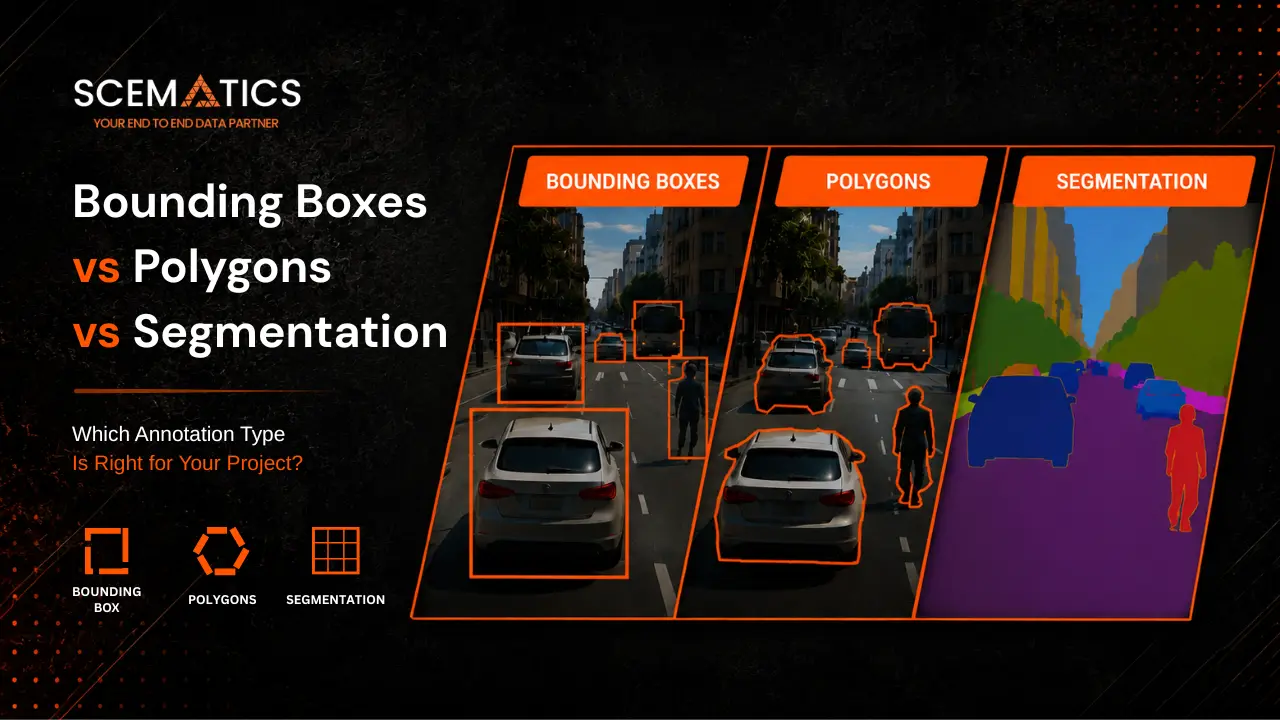
The right annotation type depends on what your model needs to know about the objects in your images. Use bounding boxes when your model needs to locate and classify objects and shape precision is not required. Use polygon annotation when object boundaries matter but pixel-level accuracy is not needed. Use segmentation when your model needs to understand exact object shapes at pixel level.
What Each Annotation Type Encodes
Before comparing annotation types, it helps to understand what each one actually tells your model. Annotation is not just a drawing exercise. Each format encodes a different type of spatial information, and that information shapes what the model can and cannot learn.
Bounding Box Annotation
A bounding box is a rectangle defined by two corner points or by a center point plus width and height. It tells the model that an object of a certain class exists at a certain location within a rectangular region.What the model learns: the object exists, its approximate location, its class. What the model does not learn: the object exact shape, which pixels belong to the object versus the background within the box.
Polygon Annotation
Polygon annotation traces the actual outline of an object using a series of connected anchor points. The result is a closed shape that follows the object real contour rather than approximating it with a rectangle. A polygon can have as few as 3 anchor points for a triangular object or 50 or more for complex irregular shapes.What the model learns: the object class and its precise boundary. What the model does not learn: which interior pixels belong to the object without additional processing, though polygons can be converted to segmentation masks.
Semantic Segmentation
Semantic segmentation assigns a class label to every single pixel in an image. A pixel can only belong to one class. All objects of the same class share the same label regardless of whether they are physically separate objects. Two adjacent cars are both labeled car with no distinction between them.What the model learns: a dense understanding of what every part of the scene is. What the model does not learn: which instance of a class individual pixels belong to.
Instance Segmentation
Instance segmentation combines object detection and segmentation: it identifies each individual object and assigns a unique pixel-level mask to each one. Two cars in the same frame are labeled as separate instances with separate masks, not as a single car region.
What the model learns: what every pixel is, which specific object each pixel belongs to, and how many individual objects of each class are in the scene.
Bounding Box Annotation: Fast, Flexible, and Widely Supported
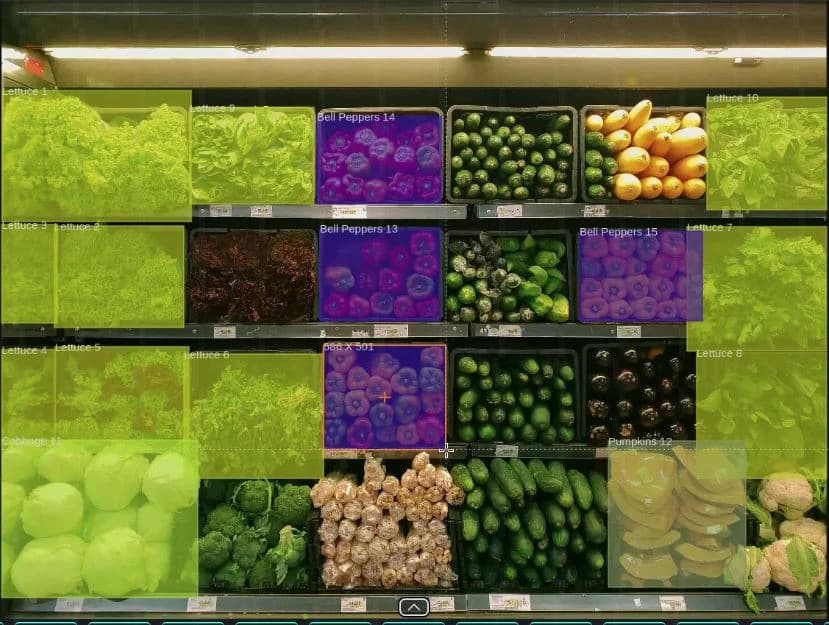
A bounding box is the most widely used annotation type in computer vision. It is the default format for object detection and the starting point for most production labeling pipelines.
When to Use Bounding Box Annotation
Real-World Use Cases for Bounding Box Annotation
Limitations of Bounding Box Annotation
Polygon Annotation: Better Precision, Proportional Effort
Polygon annotation traces the actual outline of an object using anchor points. It sits between bounding boxes and full segmentation in terms of both precision and cost, making it the practical choice for a wide range of production use cases.
When to Use Polygon Annotation
Real-World Use Cases for Polygon Annotation
Polygon Annotation Cost and Speed
Segmentation Annotation: Pixel-Level Detail for Demanding Applications

Segmentation annotation assigns a label to every pixel in an image. It is the highest-precision annotation format available and also the most time-intensive to produce. It belongs on projects where pixel-level accuracy directly affects the application outcome.
When to Use Semantic Segmentation
When to Use Instance Segmentation
Real-World Use Cases for Segmentation Annotation
Annotation Types Comparison: At a Glance
The comparison table below covers the key decision dimensions for bounding box, polygon, and segmentation annotation. Use it to map annotation type requirements directly to your project constraints.
| Criteria | Bounding Box | Polygon | Semantic Segmentation | Instance Segmentation |
|---|---|---|---|---|
| Annotation Speed | Fastest (100s per hour) | 3x to 10x slower than bounding box | Slowest (pixel-level work) | Slowest (pixel-level per instance) |
| Spatial Precision | Low (includes background noise) | High (traces object boundary) | Highest (pixel level) | Highest (pixel level per instance) |
| Annotation Cost | Lowest | Moderate | High | Highest |
| Model Architectures | YOLO, Faster R-CNN, SSD, EfficientDet | Mask R-CNN, YOLOv8-seg | U-Net, DeepLab, FCN, SegFormer | Mask R-CNN, YOLOv8-seg, SOLOv2 |
| Primary Use Cases | Retail, security, logistics, traffic | Autonomous vehicles, medical imaging, aerial | Scene understanding, satellite, robotics | Cell counting, bin-picking, crowd tracking |
| Export Formats | YOLO TXT, PASCAL VOC, COCO JSON, CSV | COCO JSON, YOLO-seg TXT | COCO segmentation, Mask PNG | COCO JSON (polygon or RLE) |
| Object Overlap Handling | Poor (boxes overlap) | Good (outlines separate cleanly) | Excellent (per-pixel class) | Excellent (per-pixel per instance) |
| AI-Assist Available | Yes (auto-detection) | Yes (SAM 3 outline suggestion) | Yes (mask generation) | Yes (SAM 3 instance masking) |
How to Choose the Right Annotation Type: A Decision Framework
Choosing an annotation type is a resource allocation decision. The right format is not always the most precise one. It is the one that gives your model what it actually needs to perform the task at the lowest sustainable cost per labelled image.
Question 1: What Does Your Model Need to Know?
Question 2: What Is the Geometry of Your Objects?
Question 3: What Is the Annotation Budget and Volume?
Question 4: What Model Architecture Is Your Team Targeting?
Mixing Annotation Types in Production
Most production computer vision pipelines do not use a single annotation type across the entire dataset. They use different formats for different object classes depending on how much precision each class requires.
Why Mixing Is a Valid Strategy
Practical Examples of Mixed Annotation Pipelines
Platform Requirements for Mixed Annotation
AI-Assisted Annotation: Closing the Speed Gap Between Formats
The cost difference between bounding box and polygon or segmentation annotation has historically been the primary reason teams choose lower-precision formats. AI-assisted annotation tools are narrowing that gap substantially.
How AI-Assisted Annotation Works
AI Assistance Across Annotation Types
When AI Assistance Has Limits
Export Formats and Model Compatibility
The annotation format you use and the export format your labeling platform produces must be compatible with your training framework. Mismatches between annotation format and model architecture are a common source of wasted labeling work.
Bounding Box Export Formats
Polygon Annotation Export Formats
Segmentation Export Formats
Annotation Type Comparison: Frequently Asked Questions
What is the difference between bounding box and polygon annotation?
When should I use bounding box annotation instead of segmentation?
How much more expensive is polygon annotation than bounding box?
Is polygon annotation the same as segmentation?
What annotation type does YOLO use?
How do I annotate overlapping objects?
Where can I start annotating with all three formats in one platform?
Start with the Right Annotation Format
Scematics gives your team bounding boxes, polygon annotation, polylines, keypoints, semantic segmentation, and instance segmentation within a single annotation platform, with SAM 3 AI assistance available across all types. Both self-serve and managed annotation service options are available for projects of any scale.If you are scoping an annotation project and unsure which format fits your use case, the Scematics team can help you evaluate annotation type options based on your dataset, model architecture, and accuracy requirements.
Scematics Copyrights Reserved
Post comments
Comments