SAM 2 vs SAM 3: What Changed, What It Means for Data Annotation, and Why It Matters in 2026

Share
  • When Meta released the original Segment Anything Model in April 2023, it fundamentally changed the economics of image annotation. For the first time, a general-purpose foundation model could generate precise segmentation masks from a single point click, without any task-specific training. That capability, once requiring specialist annotators with specialist tooling, became accessible through an open-source model that any computer vision team could integrate.
  • In this guide we examine what SAM 2 established, what SAM 3 adds beyond it, the published 2026 benchmarks that quantify the difference, and what both models mean for annotation workflows in practice.
  • Quick Answer: SAM 2 vs SAM 3
    SAM 2 vs SAM 3: What Changed, What It Means for Data Annotation, and Why It Matters in 2026

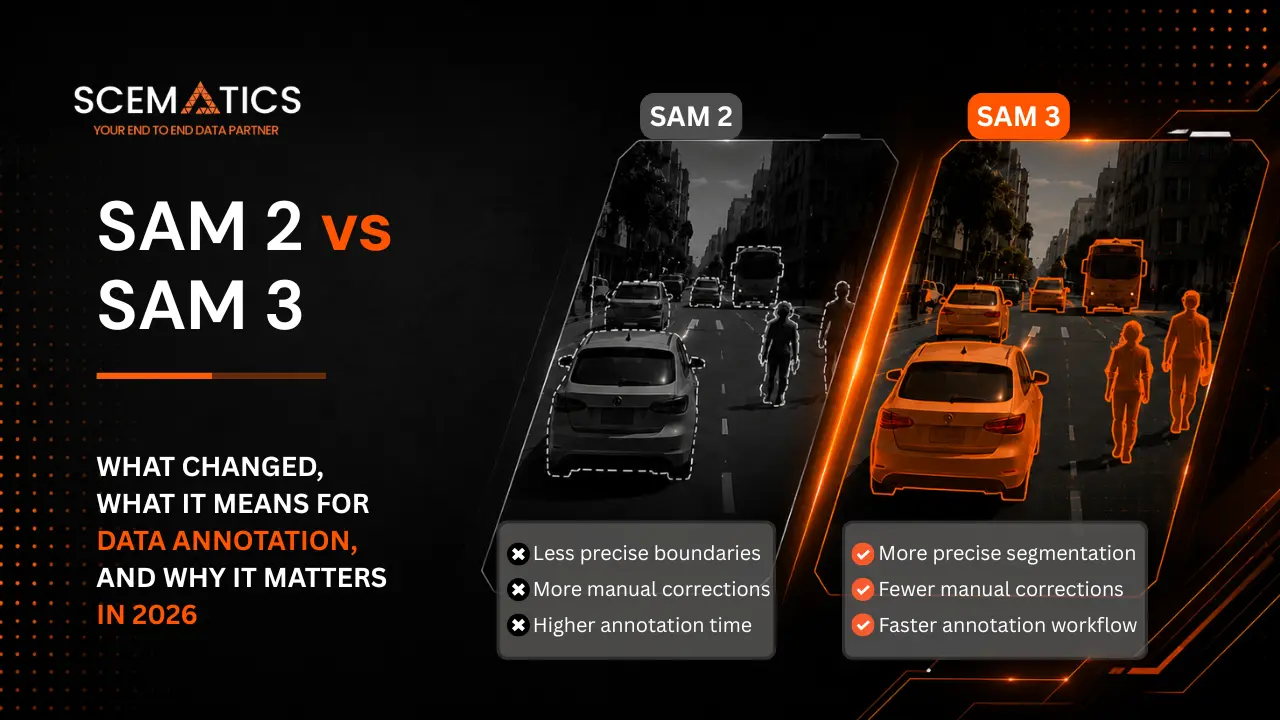
    SAM 2 added video segmentation to the Segment Anything Model through a streaming memory architecture, requiring visual prompts (clicks, boxes) to identify objects. SAM 3 added text and exemplar prompts through Promptable Concept Segmentation, a Perception Encoder pre-trained on 5.4 billion image-text pairs, and a Presence Head that reduces false positives. For annotation workflows: use SAM 2 for fast interactive mask generation on known objects; use SAM 3 for concept-level discovery across large datasets using text prompts.

  • SAM 2: point, box, and mask prompts; video tracking via streaming memory; 30 FPS performance; 3x fewer interactions than prior video segmentation methods
  • SAM 3: text and exemplar prompts; Promptable Concept Segmentation (all instances from one text input); Perception Encoder (5.4B image-text pairs); Presence Head (reduced false positives)
  • Key difference: SAM 2 accelerates mask generation on known objects; SAM 3 eliminates the manual object discovery step at scale
  • Best practice: use SAM 3 for dataset-level concept discovery and SAM 2-style interactive refinement for individual instance correction
  • The SAM Family: A Brief Timeline Before the Comparison

    Understanding the SAM 2 vs SAM 3 comparison requires knowing what each model was designed to solve, because they were not simply incremental updates to the same problem.

    ModelRelease DateCore AdvancePrimary Use Case
    SAM 1April 2023Promptable segmentation for static images using point, box, and mask inputsInteractive image annotation, zero-shot image segmentation
    SAM 2July 2024Extended segmentation to video via streaming memory architecture; 6x faster than SAM 1 on imagesVideo annotation, object tracking across frames, real-time video segmentation
    SAM 2.1September 2024Improved checkpoints for visually similar objects and occlusion handling; added training codeProduction annotation pipelines requiring stronger checkpoint performance
    SAM 3November 2025Text and exemplar prompts for concept-level segmentation; Promptable Concept Segmentation (PCS) task introducedOpen-vocabulary annotation, concept-level tracking, multi-instance detection from text

    What SAM 2 Established

    SAM 2 vs SAM 3: What Changed, What It Means for Data Annotation, and Why It Matters in 2026

    Before evaluating what SAM 3 adds, it is worth being precise about what SAM 2 actually solved, because both models remain relevant and serve different use cases in 2026.

    Video Segmentation Through Streaming Memory

    The defining architectural contribution of SAM 2 was its per-session memory module. Earlier approaches to video segmentation required processing the entire video before making predictions, or relied on frame-by-frame models that lost object state between frames. SAM 2 introduced a streaming architecture that processes video frames sequentially in real time, maintaining a memory of the target object across frames.That memory module gives SAM 2 object permanence. When a tracked object is temporarily occluded by another object passing in front of it, SAM 2 maintains the object state and resumes accurate tracking when it reappears. This made SAM 2 directly applicable to autonomous vehicle annotation, sports analytics, and surveillance footage labeling, where objects regularly disappear behind other objects.

    Published Performance Figures from Meta

  • Image segmentation speed: SAM 2 is 6 times faster than SAM 1 on image segmentation tasks, measured on a single A100 GPU
  • Video segmentation interaction efficiency: SAM 2 requires 3 times fewer user interactions than prior state-of-the-art video segmentation methods to achieve comparable accuracy
  • Annotation pipeline speed: Meta annotation tool using SAM 2 in the loop is 8.4 times faster than using SAM 1 frame by frame, and significantly faster than combining SAM 1 with a separate tracker
  • Real-time performance: SAM 2 achieves 30 or more frames per second on all but its largest model variant, making it viable for real-time interactive applications
  • Benchmark results: SAM 2 achieved state-of-the-art performance on MOSE, DAVIS17, and YTVOS19 video object segmentation benchmarks at release
  • What SAM 2 Could Not Do

    SAM 2 retained one fundamental constraint from its predecessor: it required visual prompts. To segment an object, the user had to identify it by clicking on it, drawing a bounding box around it, or providing a mask. The model had no mechanism for accepting a textual description of what to find.This meant that for any annotation task involving a class of objects distributed throughout a large image set, a human annotator still needed to click on each individual object instance to initiate segmentation. SAM 2 accelerated the segmentation step dramatically, but it did not reduce the burden of object discovery in large datasets. That is the problem SAM 3 was built to address.

    What SAM 3 Introduces: The Architectural Differences

    SAM 3 is not simply SAM 2 with a language model attached. The architecture was substantially redesigned to support a new task called Promptable Concept Segmentation, and several of the core components were rebuilt to make that task work reliably.

    Promptable Concept Segmentation

    Promptable Concept Segmentation (PCS) is the task of finding and segmenting all instances of a visual concept in an image or video, given a concept specified by text or an image exemplar. Where SAM 2 segments a single object per visual prompt, SAM 3 segments all instances of a category simultaneously from a text prompt.Type 'construction helmet' and SAM 3 identifies and masks every construction helmet in the scene, not just the one a user clicked on. This is qualitatively different from SAM 2 operation, and the applications for annotation pipelines are significant. A dataset of 50,000 construction site images that previously required an annotator to click on each helmet individually can now be pre-annotated at the concept level, with human review applied to the outputs rather than to initial identification.

    The Perception Encoder Backbone

    SAM 3 introduces a joint vision-language encoder called the Perception Encoder, which Meta released separately in April 2025. The Perception Encoder was pre-trained on 5.4 billion image-text pairs, giving SAM 3 a strong semantic understanding of visual concepts that earlier SAM models entirely lacked.The vision encoder carries 450 million parameters and the text encoder carries 300 million parameters, producing aligned visual and textual representations that enable open-vocabulary segmentation. This is the foundation that makes text prompting reliable rather than approximate. Earlier attempts to combine language models with segmentation models produced systems that could be easily confused by similar categories, particularly in crowded scenes. The Perception Encoder joint training on paired image-text data provides the semantic grounding needed for precise concept-level discrimination.

    The Presence Head

    One of the practical problems with open-vocabulary object detection is false positive hallucination. When a model is asked to find an object that is not present in the image, many architectures attempt to localize the most object-like region anyway, because they are optimized to produce detections rather than to recognize absence. In annotation workflows, false positives require human review time to reject, which erodes the throughput advantage of automation.SAM 3 addresses this with a dedicated Presence Head, a component that decouples recognition from localization. Before attempting to localize an object, the Presence Head independently predicts whether the queried concept exists in the scene. If the prediction is negative, no localization is attempted. This design significantly reduces false positive rate, which matters both for annotation quality and for the practical usability of concept-level prompting in production workflows.

    SAM 2 vs SAM 3: Head-to-Head Comparison

    The table below covers the key technical and practical differences between SAM 2 and SAM 3 for annotation teams evaluating which model to integrate.

    DimensionSAM 2SAM 3
    Release DateJuly 2024 (SAM 2.1: September 2024)November 2025
    Prompt TypesPoint, bounding box, mask (visual prompts only)Point, box, mask, text, image exemplar
    Segmentation TaskSingle object per promptAll instances of a concept per text prompt (PCS)
    Image BackboneHiera image encoderPerception Encoder (450M params, pre-trained on 5.4B image-text pairs)
    Language UnderstandingNonePerception Encoder text component (300M params, aligned with vision encoder)
    False Positive HandlingNo dedicated mechanismPresence Head decouples recognition from localization
    Video SupportStreaming memory for object tracking across framesInherited from SAM 2, extended with text-prompted concept tracking
    Object Discovery at ScaleRequires manual click per instanceText prompt finds all instances automatically across dataset
    Best Annotation Use CaseInteractive mask generation on known objectsConcept-level pre-annotation across large datasets
    Model Size Trade-offSmaller, faster for simple interactive tasksLarger compute footprint due to language encoder
    Open VocabularyNoYes
    Scematics IntegrationSupportedNatively integrated with BYOM option

    SAM 2 in Annotation Workflows: Where It Still Belongs

    SAM 2 remains a highly capable and well-understood tool in 2026. For annotation workflows where the annotator knows exactly which object instances to label and needs to produce precise masks quickly, SAM 2 is the right choice.

    Where SAM 2 Remains the Appropriate Tool

  • Interactive annotation of known objects: annotators are reviewing images sequentially, the objects to label are visible, and point-and-click mask generation is the workflow
  • Video annotation with frame-to-frame tracking: objects need to be tracked through video sequences with occlusion handling; SAM 2 streaming memory handles this efficiently
  • Resource-constrained infrastructure: SAM 2 is smaller and faster than SAM 3 for simple interactive tasks; teams with GPU constraints should evaluate whether SAM 3 capabilities justify its additional compute requirements
  • Correction and refinement workflows: when SAM 3 concept-level pre-annotations require per-instance corrections, SAM 2-style interactive visual refinement is the appropriate tool for the correction stage
  • Well-defined annotation schemas: datasets where all object classes are known in advance, instances are visually distinctive, and annotators can work through images efficiently without needing text-based discovery
  • SAM 2 Benchmark Context

  • 6x faster than SAM 1 on image segmentation on a single A100 GPU
  • 8.4x faster than SAM 1 frame-by-frame annotation in Meta production tool benchmarks
  • 3x fewer user interactions than prior state-of-the-art video segmentation methods
  • 30 or more FPS on all but the largest model variant, enabling real-time interactive annotation
  • State-of-the-art on MOSE, DAVIS17, and YTVOS19 video object segmentation benchmarks at release
  • SAM 3 in Annotation Workflows: Where It Changes the Calculation

    SAM 2 vs SAM 3: What Changed, What It Means for Data Annotation, and Why It Matters in 2026

    SAM 3 addresses a different bottleneck from SAM 2: the cost of object discovery at scale. In any large annotation project where the same category of object appears across thousands of images, the most time-consuming step is not drawing the mask around a known object. It is finding all instances of the object across the dataset.

    Where SAM 3 Changes Annotation Economics

  • Large-scale concept annotation: datasets of tens of thousands of images where the same object category appears repeatedly; SAM 3 text prompting generates candidate masks for all instances at once, with human review applied to outputs rather than to discovery
  • Rare category annotation: class imbalance in training data is often a consequence of annotation economics. Rare objects are underrepresented because finding and labeling them is disproportionately expensive. SAM 3 open-vocabulary prompting makes it practical to systematically annotate rare categories that would previously have required annotators to scan images manually
  • Open-vocabulary annotation tasks: annotation schemas where new categories are added iteratively, or where the full category list is not known in advance; SAM 3 text prompts accommodate new categories without requiring model fine-tuning
  • Multi-instance counting and coverage tasks: applications that require finding every instance of a category in a scene (safety equipment compliance, inventory auditing, ecological surveys) benefit from SAM 3 exhaustive concept-level detection
  • Cross-dataset concept consistency: using a text prompt ensures that the same concept definition is applied consistently across all images in a dataset, reducing annotator interpretation variance for ambiguous categories
  • Annotation Cost Reduction with SAM 3

  • SAM 3 concept-level pre-annotation shifts the annotator role from object finding and drawing to reviewing and correcting AI-generated masks
  • For datasets with high instance density of common categories, the throughput gain from eliminating per-instance clicking compounds significantly at scale
  • The Presence Head false positive reduction means fewer incorrect detections reach human review queues, reducing wasted review time
  • Text-prompted annotation enables non-expert reviewers to validate masks without requiring annotators who can recognize the object category visually in ambiguous or specialized imagery
  • Combining SAM 2 and SAM 3 in a Single Pipeline

    For most production annotation teams, the practical decision is not which model to use exclusively, but which capability to apply to which stage of the annotation workflow. SAM 2 and SAM 3 address different bottlenecks and work best together.

    The Hybrid Pipeline Pattern

  • Stage 1 (SAM 3): run text-prompted Promptable Concept Segmentation across the full dataset to generate candidate masks for each target category. This produces a pre-annotated dataset with concept-level coverage.
  • Stage 2 (human review): annotators review SAM 3 outputs, approve correct masks, reject false positives that passed the Presence Head, and flag instances requiring correction
  • Stage 3 (interactive refinement): use SAM 2-style point and box interactive prompting on flagged instances to generate corrected masks. Annotators click on the object and receive a precise mask without redrawing from scratch.
  • Stage 4 (QA): inter-annotator agreement checks on a sampled subset of the labelled dataset to validate consistency before export
  • When to Use SAM 2 Only

  • The annotation task is straightforward interactive image or video labeling
  • Dataset volume is moderate and annotators can work efficiently with visual prompts
  • GPU compute is constrained and SAM 3 language encoder overhead is not justified by the task requirements
  • The annotation schema is fully defined and no open-vocabulary discovery is required
  • When to Use SAM 3 Only

  • The annotation task is concept-level pre-annotation of a large dataset where all instances of a text-specified category need to be found
  • The dataset contains rare or hard-to-find object categories that benefit from systematic exhaustive discovery
  • The annotation team is performing initial triage or coverage assessment across a large image corpus
  • Open-vocabulary or iteratively expanding annotation schemas require text-based prompting flexibility
  • How Scematics Integrates SAM 3

    Scematics integrates SAM 3 natively into its annotation platform. Annotators working on image and video datasets can use text prompts to generate concept-level pre-annotations across a dataset, then apply human review to the outputs.

    Text-Prompted Pre-Annotation in Scematics

  • Annotators specify a target category by text description and SAM 3 generates candidate masks across the dataset automatically
  • Human review queues present SAM 3 outputs for approve, reject, or correct decisions, shifting annotator time from drawing to reviewing
  • Approved masks are stored in the project annotation set; rejected false positives are logged for model feedback
  • Corrected instances can be fed back as fine-tuning data to improve SAM 3 performance on domain-specific categories over time
  • Bring-Your-Own-Model (BYOM) Workflows

  • For teams with domain-specific models fine-tuned on their own data, Scematics supports bring-your-own-model workflows, allowing a custom model to serve as the pre-annotation engine in place of or alongside SAM 3
  • This is particularly relevant in specialized annotation domains such as medical imaging, satellite analysis, and industrial inspection, where a fine-tuned model trained on domain-specific data outperforms a general-purpose foundation model for that specific task
  • BYOM and SAM 3 can be used in parallel, with domain-specific models handling familiar categories and SAM 3 handling open-vocabulary discovery for new or rare categories
  • Related Scematics Resources

  • Annotation Platform: scematics.io/Product/DataAnnotation
  • Labeling Services: scematics.io/Service/LabelingService
  • Industries We Serve: scematics.io/Industry
  • SAM 2 vs SAM 3: A Decision Guide for Annotation Teams

    Use the criteria below to determine which model or combination of models is appropriate for your annotation project.

    Use SAM 2 When

  • Annotators are working interactively through images or video and clicking on known, visible objects
  • The task requires precise mask generation for individual instances that have already been identified
  • Video annotation with frame-to-frame object tracking is required
  • Compute resources are constrained and SAM 3 language encoder overhead is not justified by the task
  • The annotation schema is fixed and no open-vocabulary discovery is needed
  • Use SAM 3 When

  • You need to find all instances of a concept across a large dataset using a text prompt
  • The object category is rare, visually ambiguous, or time-consuming to locate manually
  • You are working with an open-vocabulary or iteratively expanding annotation schema
  • Reducing class imbalance by systematically targeting underrepresented categories is a priority
  • Dataset coverage audit is required (confirming all instances of a category have been annotated)
  • Use Both in Combination When

  • SAM 3 handles concept-level discovery across the dataset to generate candidate masks, and SAM 2-style visual prompt refinement is applied to individual instances that require correction
  • The dataset contains a mix of common categories (well-served by SAM 2 interactive annotation) and rare or open-vocabulary categories (well-served by SAM 3 text prompting)
  • Large-scale production annotation pipelines need both maximum throughput (SAM 3 pre-annotation) and high per-instance precision (SAM 2 refinement)
  • SAM 2 vs SAM 3: Frequently Asked Questions

    What is the main difference between SAM 2 and SAM 3?

  • SAM 2 extended the Segment Anything Model to video through a streaming memory architecture and requires visual prompts (point clicks, bounding boxes) to segment objects. SAM 3 adds text and exemplar prompts through the Promptable Concept Segmentation task, allowing a text description to identify and segment all instances of a concept simultaneously. SAM 3 also introduces the Perception Encoder (trained on 5.4 billion image-text pairs) and a Presence Head that reduces false positive detections.
  • Is SAM 3 better than SAM 2 for data annotation?

  • SAM 3 and SAM 2 address different annotation bottlenecks. SAM 2 is faster and more efficient for interactive annotation where annotators click on known objects to produce precise masks. SAM 3 is superior for concept-level discovery across large datasets, where text prompting replaces manual object finding. Most production annotation pipelines benefit from using both at different stages of the workflow.
  • What is Promptable Concept Segmentation?

  • Promptable Concept Segmentation (PCS) is a task introduced with SAM 3. It involves finding and segmenting all instances of a visual concept in an image or video given a concept specified by text or an image exemplar. Where SAM 2 segments a single object per visual prompt, SAM 3 PCS segments all instances of a category simultaneously from a text input. This enables open-vocabulary annotation at dataset scale.
  • What is the Perception Encoder in SAM 3?

  • The Perception Encoder is a joint vision-language encoder introduced with SAM 3 and released separately by Meta in April 2025. It was pre-trained on 5.4 billion image-text pairs. The vision encoder carries 450 million parameters and the text encoder carries 300 million parameters. The two encoders produce aligned visual and textual representations that enable reliable open-vocabulary segmentation from text prompts.
  • What is the Presence Head in SAM 3?

  • The Presence Head is a dedicated component in SAM 3 that decouples recognition from localization. Before attempting to locate and segment an object, the Presence Head independently predicts whether the queried concept exists in the scene. If the prediction is negative, no localization is attempted. This design reduces false positive rates, which matters in annotation workflows because false positives require human review time to reject.
  • Does SAM 3 work for video annotation?

  • Yes. SAM 3 supports both image and video segmentation. It inherits SAM 2 video capabilities including streaming memory for object tracking across frames and occlusion handling, and extends them with text-prompted concept segmentation. This means SAM 3 can find all instances of a concept across video frames, not just track a specific instance that was manually identified.
  • When was SAM 3 released?

  • Meta released SAM 3 (Segment Anything Model 3) in November 2025. The Perception Encoder, a core component of SAM 3 architecture, was released separately by Meta in April 2025. SAM 2 was released in July 2024, and SAM 2.1 (improved checkpoints for visually similar objects and occlusion handling, with training code) was released in September 2024.
  • Start Annotating with SAM 3 on Scematics

    Scematics gives your team SAM 3 native integration for text-prompted concept-level pre-annotation, alongside support for SAM 2-style interactive visual annotation, polylines, keypoints, bounding boxes, and polygon annotation, all within a single platform. Bring-your-own-model support is available for teams with domain-specific fine-tuned models.Whether you are starting a new annotation project or evaluating how SAM 3 could reduce annotation costs on an existing pipeline, the Scematics team can help you assess which model configuration fits your dataset, annotation schema, and accuracy requirements.

    Scematics Copyrights Reserved

    Post comments

    Comments