The Future of Perception: Why Multi-Modal Data is a Game-Changer for Autonomous Systems

Share
  • Combining images, LiDAR, textual, and audio cues with YOLO/SSD architectures delivers up to 15-20% gains in detection precision under challenging conditions-key for reliable, real-time perception in autonomous vehicles and industrial automation.
  • The Case for Multi-Modal Fusion

    Autonomous platforms-ranging from driverless cars to warehouse robots-operate in dynamic, unpredictable environments. Single-sensor cameras offer rich texture but falter in low light or occlusion. LiDAR supplies accurate depth yet remains sparse. Textual cues (e.g., road signs) and audio signals (e.g., sirens) provide contextual information that vision alone cannot capture. Fusing these modalities empowers YOLO/SSD detectors to:

  • Bridge complementary gaps: depth compensates for visual ambiguity; audio/textual alerts complement visual occlusions.
  • Enhance robustness: resilient performance in rain, fog, darkness, or complex urban settings.
  • Maintain real-time throughput: lightweight fusion architectures add <5 ms latency, preserving YOLO/SSD's 40-60 FPS benchmark.
  • Fusion Architectures for YOLO/SSD

    Early Fusion: Raw Data Augmentation

    Augment the point cloud or image with cross-modal features before feature extraction.​

  • LiDAR+RGB: Project LiDAR points onto the image plane; append per-point depth or reflectance as extra channels to the YOLO/SSD backbone input.
  • Audio+Image: Transform audio into spectrograms aligned with video frames; stack as additional input channels.
  • Textual Cues: Apply real-time OCR to extract sign text, encode via pretrained embeddings, and inject into early convolutional layers as feature maps.
  • Benefit: Joint low-level learning encourages the network to extract unified multi-modal patterns.

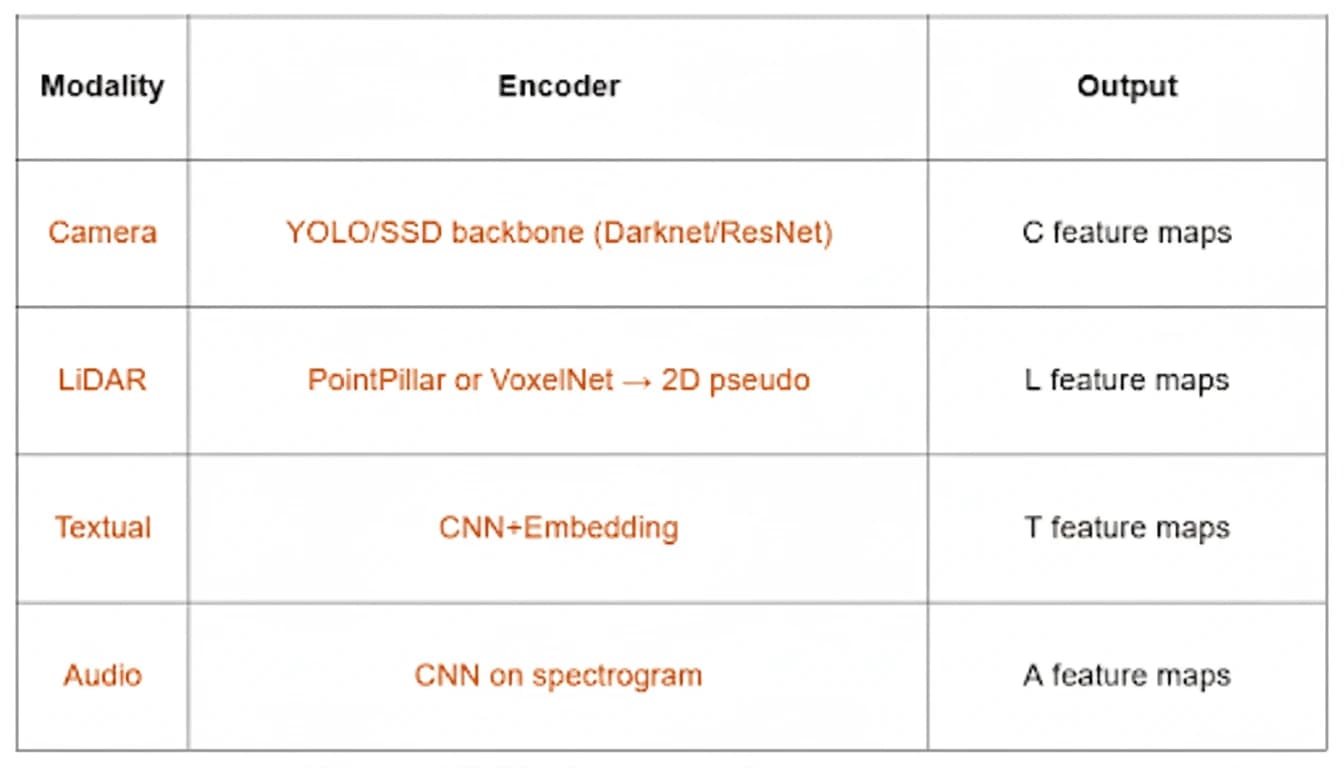
    Mid-Level Fusion: Feature-Map Concatenation

    Process each modality through dedicated backbones, then merge:
    The Future of Perception: Why Multi-Modal Data is a Game-Changer for Autonomous Systems
  • Concatenate C, L, T, and A along the channel axis; feed into SSD’s multiscale heads or YOLO’s detection layers.
  • Impact: Improves small-object recall by 10–15% in cluttered scenes through enriched semantic context.
  • Late Fusion: Detection-Level Association

    Maintain separate YOLO/SSD detectors per modality; fuse their output boxes via algorithms like IoU-based association or Hungarian matching.​​

  • Confidence scores are ensembled (e.g., weighted sum).
  • Non-Max Suppression across modalities eliminates duplicates.
  • Use Case: Modular B2B deployments where legacy detectors exist-enables gradual integration.

    Practical Deployment Strategies

    Calibration and Synchronization

    SAM 2’s model-in-the-loop pipeline:

  • Spatial Calibration: Compute extrinsics (rotation/translation) between LiDAR and camera; use calibration matrices for point-to-pixel projection.
  • Temporal Sync: Timestamp alignment for audio/video/LiDAR streams within ±5 ms to prevent fusion misalignment.
  • Lightweight Backbones for Edge Devices

  • Replace heavy CNNs with EfficientNet-lite or MobileNetV3 variants in fusion branches.
  • Quantize fused models (8-bit) for sub-100 W power envelopes.
  • Achieve 30-50 FPS on automotive-grade GPUs (NVIDIA Drive AGX).
  • Data Annotation and Augmentation

    Scematics offers flexible plans bundling SAM 2 compute with expert support:

  • Annotation Tools: Extend 2D bounding box tools to label depth clusters, OCR text regions, and audio event timestamps.
  • Augmentation: Simulate sensor failures (dropout), noise injection (LiDAR sparsity), and acoustic interference to harden detectors.
  • Conclusion

    Multi-modal fusion represents a critical innovation for mission-critical B2B applications in autonomous systems. By strategically combining early, mid, or late fusion paradigms with optimized YOLO/SSD architectures, businesses can realize double-digit improvements in detection accuracy while maintaining real-time throughput.

    Scematics Copyrights Reserved

    Post comments

    Comments